A Local's Guide: Best Food in Val d'Orcia, Italy


Food of Val d'Orcia
Nestled in the heart of Tuscany, the Val d'Orcia is a UNESCO World Heritage landscape celebrated for its rolling hills, solitary cypress trees, medieval hilltop villages, and a golden light that looks like it belongs in a Renaissance painting. But there's something the most attentive travelers already know: this valley is also one of the best places to eat in all of Italy.
As someone who loves this corner of Tuscany deeply, I can say that food in Val d'Orcia is not simply nourishment — it's a cultural act. The flavors here are rooted in the clay soil, the Sangiovese vineyards, the oak forests where wild boar roam freely. Every dish tells a story of seasons, of families, of recipes whispered from one generation to the next in kitchens fragrant with rosemary.
✨ In this guide we'll first explore the 🍝 must-try dishes that define Val d'Orcia food culture, and then I'll share 🍴 my personal recommendations for the best places to taste them. Let's embark on a culinary journey through Montalcino, Pienza, Bagno Vignoni, and beyond.
Where I Stayed
Finding the right base makes all the difference in Val d'Orcia — distances between villages are short, but the countryside roads are winding and best explored without rushing. I stayed at Apartment in the medieval village, and it was the perfect launchpad for day trips to Montalcino, Pienza, and Montepulciano.
👉 Apartment in the medieval village 🅱️ Booking 🔗
Pici al Ragù di Cinghiale
If there's one dish that embodies the soul of Val d'Orcia more than any other, it's pici. These thick, hand-rolled pasta strands — resembling oversized spaghetti pulled by hand — have a rough, porous texture that clings to sauces beautifully. The classic condiment of the area is wild boar ragù: a slow-cooked sauce fragrant with juniper, red wine, and wild herbs, made from the cinghiale that roam the surrounding countryside.
It's a peasant dish that became noble. Simple in its ingredients, complex in its flavors. Completely impossible to resist.
👉 Some of the best pici al cinghiale can be found at Trattoria Osticcio in Montalcino🔗, where the pasta is made by hand every single morning

🎟️ Want to learn to make them yourself? Traditional Tuscan Recipes at a Local Home in Val d'Orcia🔗 — a cooking class held in a private home where you'll make pici from scratch alongside a local family. One of the most memorable things you can do in the valley.
Pecorino di Pienza
Pienza is the world capital of pecorino. This Renaissance village, commissioned by Pope Pius II as his ideal city, also has a unique dairy identity: the pecorino produced here has unmistakable characteristics thanks to the fragrant pastures of Val d'Orcia, where sheep graze on wildflowers, thyme, and savory.
You'll find it fresh (delicate and milky), semi-aged (creamy with a hint of spice), or fully aged (hard, intense, perfect for grating or pairing with honey). There are also wonderful versions matured under ash, under walnut leaves, or even in Barolo wine barrels.
✨ Don't miss the chance to do a tasting at the little shops along Pienza's main street, where local producers will let you sample every variety straight from the counter.

🎟️ Want to go deeper? Dairy Farm Tour with Pecorino Cheese Tasting🔗 — a hands-on experience visiting a working farm in the Pienza countryside. Highly recommended if you want to understand where all that flavor actually comes from.
Ribollita and Bread Soups
Val d'Orcia shares with all of Tuscany a deep love for bread soups — dishes born from the peasant philosophy of wasting nothing. Ribollita — literally "re-boiled" — is a thick soup of black kale, cannellini beans, and stale bread that is cooked, left to rest, and reheated the next day, becoming even better with time.
Similar in spirit is pappa al pomodoro, the ultimate Tuscan comfort food: bread slowly dissolved in fresh tomato sauce, extra virgin olive oil, and basil.
These are dishes that don't photograph well, but the first spoonful will tell you everything you need to know about rural Tuscany.
Cinta Senese
Cinta Senese is a native Tuscan pig breed — recognizable by the distinctive pale band across its shoulders — raised free-range among oaks and woodland. For centuries it risked extinction, replaced by more productive breeds. Today it's protected by a Slow Food Presidium and a DOP designation.
Cinta Senese pork has a richer, more complex flavor than common pork: the cured meats (salame, finocchiona, lardo) are extraordinary, but the steaks and braises reach equally memorable heights. If you see the Cinta Senese label on a menu, order it without hesitation.
👉 At Il Leccio in Sant'Angelo in Colle, Cinta Senese is practically a religion: charcuterie boards and grilled cuts that you won't soon forget.
Bistecca di Chianina
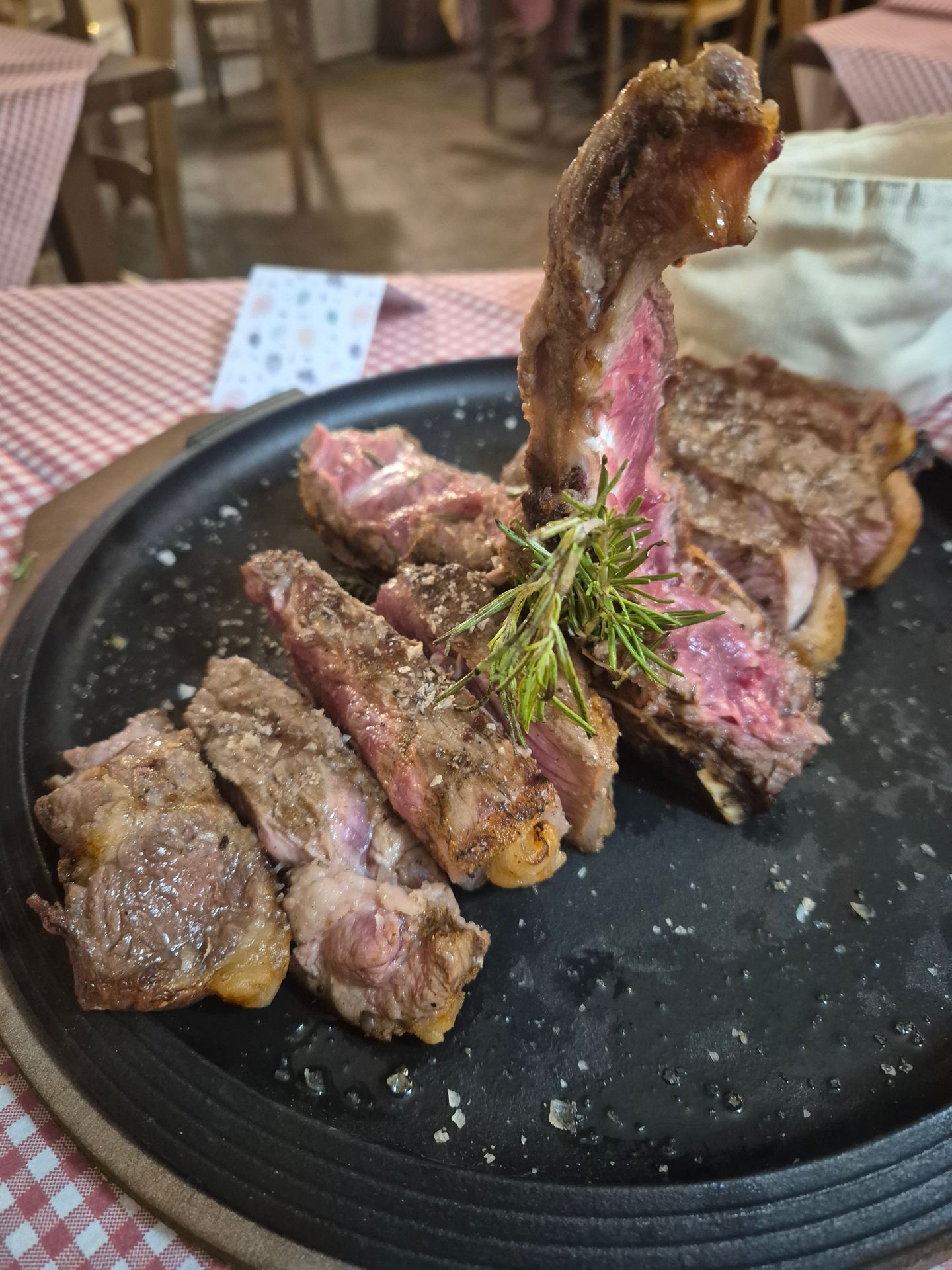
Just north of Val d'Orcia, in the Valdichiana, is the birthplace of Chianina — one of Italy's oldest cattle breeds and among the largest in the world. Its meat is the raw material for the legendary bistecca alla fiorentina, and in Val d'Orcia restaurants you'll find Chianina steaks and cuts cooked with absolute respect: oak-wood fire, coarse salt, nothing else.
A well-cooked Chianina steak — at least 4 centimeters thick, rare, with a perfect outer crust — is an almost spiritual experience for meat lovers.
⚠️ Fair warning: ordering your steak "well done" is considered a serious offense. Chianina must be eaten rare or, at most, medium-rare
Crostini with Chicken Liver Pâté
Before the pici, before the bistecca, before anything else — a Tuscan meal almost always begins with crostini neri, toasted bread rounds topped with a warm, silky chicken liver pâté. This is one of the most ancient and beloved antipasti in all of Tuscany, and in Val d'Orcia it's as non-negotiable as breathing.
The pâté is made by slowly cooking chicken livers with onion, capers, anchovies, and a splash of Vin Santo or white wine, until everything melts into a deeply savory, slightly briny spread. Served warm on crunchy toasted bread, it's rich without being heavy — and dangerously easy to eat by the dozen.
✨ Don't let the idea of liver put you off if you're not usually a fan. This is nothing like what you might expect — it's smooth, complex, and completely addictive. It's one of those bites that converts people instantly.
👉 You'll find crostini neri on virtually every antipasto plate in the area — just make sure you don't skip them in favor of something that sounds more familiar
Affettati Toscani
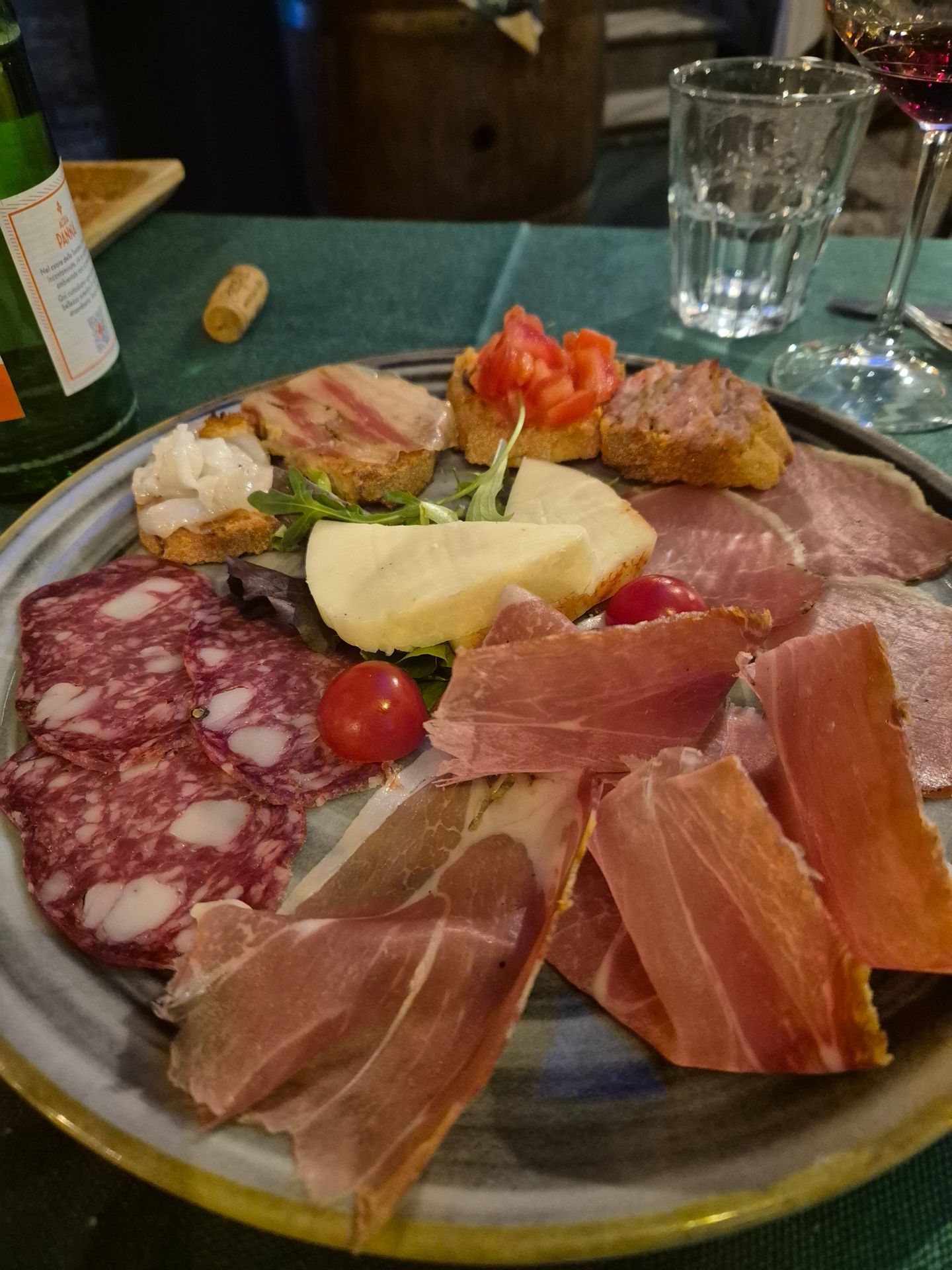
No table in Val d'Orcia starts a meal without a tagliere di affettati — a wooden board piled with the finest Tuscan cured meats. This is not the generic supermarket charcuterie you might know from home. This is something else entirely.
The stars of the board are few but mighty. Finocchiona is a soft, fennel-scented salame with a melt-in-the-mouth texture — arguably the most distinctively Tuscan cured meat there is. Lardo di Colonnata (from the marble caves of the Apuan Alps) is cured fatback so delicate it practically dissolves on warm bread. And then there's the sbriciolona, a crumbly, coarsely ground salame that falls apart between your fingers in the best possible way.
When sourced from Cinta Senese pigs (see above), every single one of these reaches another level of depth and flavor.
✨ If you're visiting Pienza, pick up a vacuum-packed selection from one of the local delis to bring home — it travels well and makes for an exceptional souvenir.
Brunello di Montalcino and Rosso di Montalcino
You simply cannot talk about food in Val d'Orcia without dedicating a full section to wine. Montalcino, the medieval hilltop town that watches over the valley, is the birthplace of Brunello — one of the most celebrated and long-lived red wines in the world, made from 100% Sangiovese Grosso (locally called Brunello).
Brunello di Montalcino DOCG ages for at least 5 years (7 for the Riserva) and develops extraordinary notes of ripe cherry, tobacco, damp earth, and spice. It's a wine for contemplation, best paired with rich red meats and aged cheeses.
For something more approachable, Rosso di Montalcino DOC — often called Brunello's younger sibling — is an excellent choice: fresher, more easy-drinking, and equally enjoyable.
👉 Don't miss a visit to the Fortezza di Montalcino, where you can taste both styles with sweeping views over the valley. For wineries, Banfi, Biondi Santi, and Col d'Orcia are historic names well worth exploring.
🎟️ For the full experience: Brunello Wine Tasting & Lunch in a Tuscan Castle🔗 — a guided tasting of Brunello and Rosso di Montalcino paired with a proper Tuscan lunch, held inside a historic estate. If you're a wine lover, this is the highlight of any Val d'Orcia trip.
Vino Nobile di Montepulciano
Head east to Montepulciano — one of Italy's most beautiful hill towns, with its cellars carved into the tufa rock beneath Renaissance palaces — and you'll find Vino Nobile di Montepulciano DOCG, also made from Sangiovese. More elegant and floral than Brunello, with notes of violet, red fruit, and a velvety tannin structure.
✨ Wandering the streets of Montepulciano and stopping into underground wine cellars for tastings is one of the finest experiences Italian wine country has to offer.
🎟️ Book ahead: Wine Tasting and Cellar Tour in Montepulciano🔗 — a guided tour through one of the historic underground cellars, with a tasting of Vino Nobile paired with local bites. Well worth adding to your itinerary.
Restaurant Recommendations in Val d'Orcia
Below are some excellent spots not to miss. The "€" reflects the price range.
- Sette Di Vino 🔗€€ — is a relaxed, easy trattoria — nothing fancy, just honest Tuscan cooking done well. I had the pici cacio e pepe and pici al ragù di cinghiale, both excellent, followed by a tagliere of local Pecorino di Pienza. The perfect Tuscan dinner.
- Ristorante Pizzeria Il Botteghino 🔗€€ — This is where I had one of the best Fiorentina steaks of my life, at incredibly accessible prices — around €50 per kg, which is very fair for a cut of this quality.
- Ristorante 13 Gobbi 🔗€€€ — Recommended to me by locals in the area. I didn't make it there this time, but when a local points you somewhere in Tuscany, you listen. On my list for next time.
- Cortona Bistrot 🔗€€€ — A charming, slightly chic spot in the heart of town. Not your typical rustic osteria, but a more refined experience — and a very good one. Worth a stop for lunch or dinner.
Exploring the food of Val d'Orcia is not just a pleasure for the palate — it's a journey through the history, landscape, and seasons of one of the most beautiful places on earth. Every forkful of pici, every sip of Brunello, every slice of pecorino carries with it something of this extraordinary land.
Buon appetito — and welcome to Val d'Orcia! 🌿