4 Days in Tropea & the Costa degli Dei: The Ultimate Itinerary


Tropea is the kind of place that looks photoshopped until you're standing in front of it — a medieval village perched on a cliff, a church floating on a rock in the sea, and water so clear it barely looks real. Four days is the perfect amount of time to explore the town properly and work your way down the Costa degli Dei, Calabria's "Coast of the Gods," from the hidden coves of Capo Vaticano to the gelato capital of Pizzo.
Base yourself in Tropea and take it slow — this is a coastline built for long lunches, cliffside sunsets, and not much else.
Heads up: this page may include affiliate links. By clicking and/or purchasing, I may receive a small commission at no extra cost for you. I only recommend tools I have personally vetted.
Practical Information
Getting There
✈️ By Plane: Fly into Lamezia Terme Airport (SUF), about 45–50 minutes from Tropea by car — the closest and most convenient airport for the whole Costa degli Dei.
👉 You can book your plane ticket here🔗
🚗 By Car: A rental car is the best way to explore properly — Capo Vaticano, Zambrone, and the inland villages are only really accessible if you're driving. Pick up your car at Lamezia Terme airport.
👉 You can book your car on Booking🔗 or on Rentalcars🔗
⚠️ Parking in Tropea's historic centre is very limited in summer — use one of the paid lots just outside the old town and walk in.
🚆 By Train: Tropea has its own station on the coastal line, and in summer Trenitalia runs the seasonal Tropea Express, a scenic service connecting Lamezia Terme with Tropea, Zambrone, Ricadi, and Parghelia. A good option if you're not renting a car, though it limits how much of the coast you can cover.
👉 You can book train tickets on the Trenitalia official website🔗
🚌 No car? Use a tour operator: You don't need to drive to see this coast properly. Boat tours from Tropea's fishermen's harbour cover the best coves of Capo Vaticano in a single trip; land-based excursions run from Tropea to Capo Vaticano and Pizzo with a guide and usually an aperitivo stop along the way; and if you're staying further south, full-day tours from Reggio Calabria also take in Tropea or Pizzo with a tartufo tasting included. For something different, a few operators run quad tours across Tropea, Capo Vaticano, and the Monte Poro plateau — a fun way to combine coast and countryside in one outing.
👉 You can book this tour here🔗
Weather
The Costa degli Dei has a classic Mediterranean climate with hot, dry summers and mild winters:
☀️ Summer (June to August): Hot, 28°C to 34°C (82°F to 93°F). Peak season — book accommodation well ahead, especially in August.
🍂 Autumn (September to October): Still warm, 20°C to 27°C (68°F to 81°F), the sea stays swimmable and the crowds thin out fast.
❄️ Winter (November to March): Mild, 10°C to 15°C (50°F to 59°F). Many beach towns are very quiet — charming, but plan for closures.
🌸 Spring (April to May): 16°C to 23°C (61°F to 73°F), green landscapes and comfortable sightseeing weather, though the sea is still cold for swimming.
Accommodation
Base yourself in Tropea for the whole trip — it's central, walkable, and puts every beach on this itinerary within a 20-minute drive.
- Luxury: Solmaris Tropea City Center 🅱️ Booking 🔗🆃 Trip 🔗🅴 Expedia 🔗
- Mid-range: B&B Laudato Sii Tropea 🅱️ Booking 🔗🆃 Trip 🔗🅴 Expedia 🔗
- Budget: B&B Vanity 🅱️ Booking 🔗 🆃 Trip 🔗🅴 Expedia 🔗
Day 1 — Tropea: Beaches, Old Town & Sunset
Tropea is the postcard of Calabria — a cluster of honey-coloured palazzi balanced on a cliff, with the sea on every side. It's genuinely small: half a day is enough to see the old town properly, so start with the beach while the morning is cool and save the village for the golden light of late afternoon and evening.
👉 Tropea's old town rewards those who know where to look — a guided walking tour🔗 uncovers the history, legends, and hidden corners you'd miss on your own.
Morning — the beach
Head straight down to the sanctuary of Santa Maria dell'Isola, a church that seems to float on its own rocky islet just off the beach, reached by a staircase carved into the stone. Behind the church, a small garden path leads to terraces cut into the rock with sweeping views up and down the coast — on a clear day you can see all the way to Stromboli. From here, drop straight onto the beach. Tropea's coastline runs for a couple of kilometres beneath the old town, with several distinct stretches to choose from:
- Spiaggia Mare Piccolo — the main beach, right below Santa Maria dell'Isola, a mix of free stretches and beach clubs (lidi)
- Spiaggia Mare Grande — wider and sandier, a little further along, popular with families
- 'A Linguata and A Rotonda — smaller, quieter coves toward the edge of town
- Spiaggia del Convento — named for the convent on the cliff above, generally less crowded than Mare Piccolo
- San Leonardo — the furthest out, a good choice if you want space and don't mind a longer walk
The water shifts from pale turquoise to deep blue within just a few metres of the shore — genuinely one of the best swimming spots in Calabria.
⚠️ In high season these beaches get extremely crowded, especially Mare Piccolo — arrive early if you want any space at all. Personally, I wouldn't spend the whole day here: one of these beaches is enough to get the picture, and I'd rather save most of my beach time for the quieter coves around Capo Vaticano on Day 2.
Afternoon & evening — Old Town
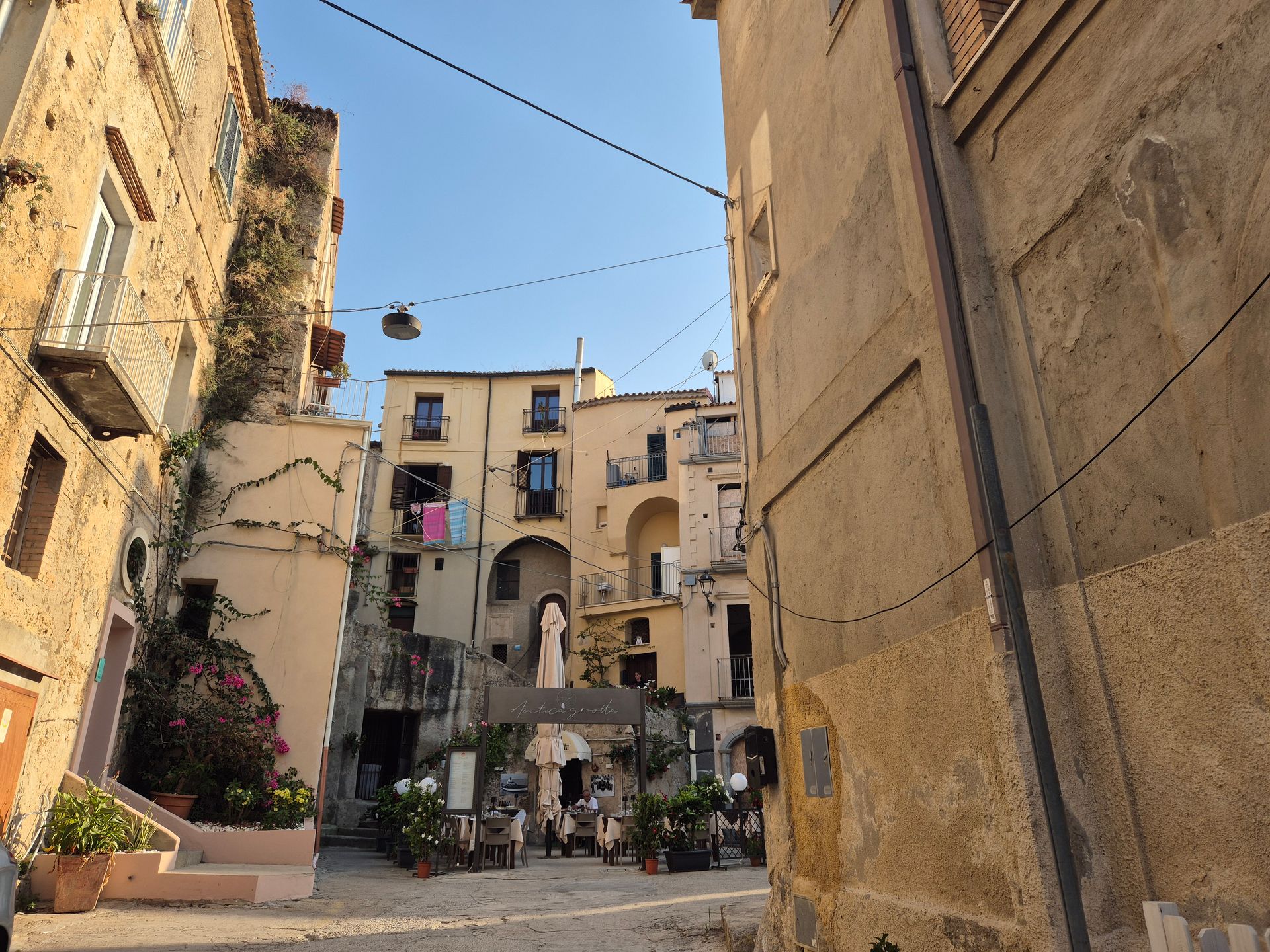
Once the heat softens, climb up to the old town. Start at Piazza Ercole, the lively main square where most of Tropea's bars and cafés spill out onto the pavement, then walk into the tangle of narrow lanes: Largo Galluppi, home to some of Tropea's grand noble palazzi, and Via Roma, one of the quieter residential streets where laundry hangs between balconies and not much has changed in decades.
Visit the Cattedrale di Tropea, a Norman-founded cathedral rebuilt several times over the centuries, which holds the icon of the Madonna di Romania — the town's patron saint, credited with protecting Tropea during earthquakes and Allied bombing raids in WWII. Inside, look out for the two unexploded bombs from 1943 still displayed near the altar, left as they fell.
Walk the length of Corso Vittorio Emanuele II, Tropea's main pedestrian street, where you'll find the town's famous red onion in every form — jam, marmalade, even gelato — alongside 'nduja, bergamot products, ceramics, and leather goods from local artisans. Time your walk to end at Largo Migliarese, the single most photographed spot in town — a stone balcony jutting out over the cliff, with Santa Maria dell'Isola and the sea spread out below. This is the spot for sunset: the light on the church and the cliffs below is genuinely one of the best moments of the whole trip, and the temperature finally drops to something comfortable for walking.
Evening
Corso Vittorio Emanuele II turns into Tropea's passeggiata and nightlife strip after dinner — bars stay lively well past midnight in summer, especially around Piazza Ercole and Largo Duomo.
✨ A word of honest advice: Tropea is very touristy, and it shows at dinner — restaurants are expensive and the quality is rarely worth the price, especially anywhere along the main streets. Those are the ones to avoid entirely. My real recommendation is to skip a sit-down dinner altogether and go for a proper aperitivo with some food instead — much better value, and it fits the relaxed mood of the evening. If you do want a real meal, steer clear of Corso Vittorio Emanuele II and the other main drags and look for something tucked into a side street instead.
👉 For gelato, don't miss Dolce Tropea – Gelateria & Tartuferia Artigianale🔗 dal 1985, known for unusual, genuinely local flavours — I had a cone with Tropea red onion and spicy chocolate gelato, and it was one of the best things I ate on the whole trip.
👉 If you're planning to eat your way through the region, don't miss my full Local's Guide to the Best Food in Calabria🔗— it's packed with everything you need to eat like a local.
Day 2 — Capo Vaticano & Ricadi
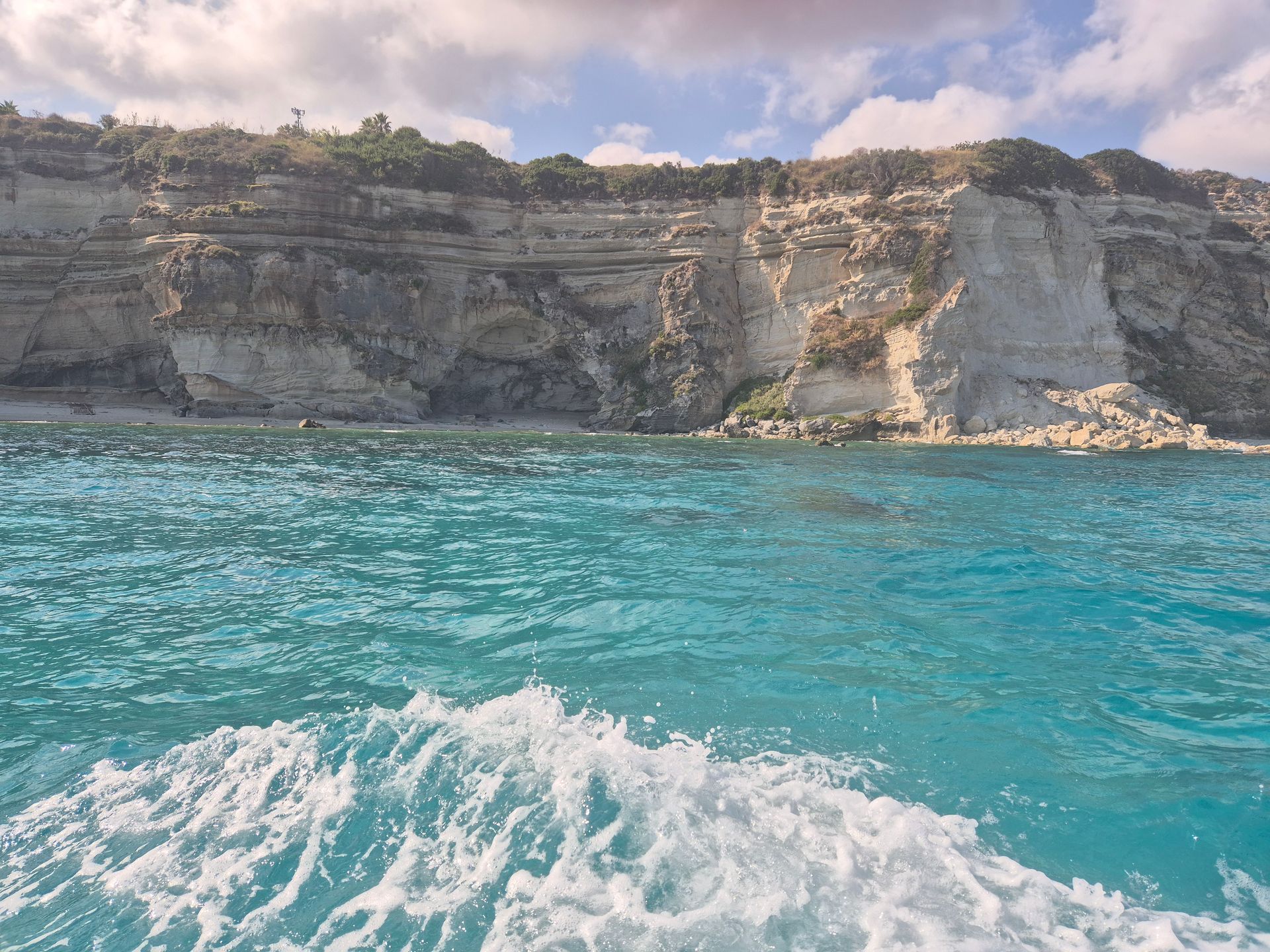
This is the day you came for. Capo Vaticano is the most dramatic stretch of the entire Costa degli Dei — a promontory of pale rock and pine trees dropping into water so clear it barely looks real, crowned by a lighthouse and framed by views across to Stromboli.
Drive about 20 minutes south from Tropea to reach the area, which spans the coastline around Ricadi and Santa Domenica di Ricadi. There's no single "best" beach here — it's a string of coves, each with its own character, so plan to move between a few over the day:
- Baia di Riaci — one of the few proper sandy beaches in the area, reached via the SP22 from Tropea, with natural rock pools where the water settles almost turquoise
- Grotticelle — the crown jewel, regularly ranked among Italy's and the world's most beautiful beaches: fine sand, granite boulders, and impossibly clear water tucked right beneath the lighthouse
- Spiaggia del Tono and Praia i Focu — quieter, rockier coves closer to the Capo Vaticano promontory itself
- Petraio and Salamite — smaller, lesser-known coves worth a stop if you want to escape the crowds
- Giardinello and Gabbaturcu, near Santa Domenica di Ricadi — good options if the main beaches are packed in high season
✨ For the best overall view, climb up to the Capo Vaticano lighthouse itself — the belvedere here is one of the best sunset spots on the entire coast, looking out over the lighthouse, the cliffs, and the Aeolian Islands in the distance.
⚠️ Access to some of the smaller coves involves steep paths or a short walk down from the road — comfortable shoes help, and note that not all beaches have facilities.
Day 3 — Parghelia & Zambrone
A slower day, split between two quieter villages away from Tropea's crowds.
Morning — Parghelia
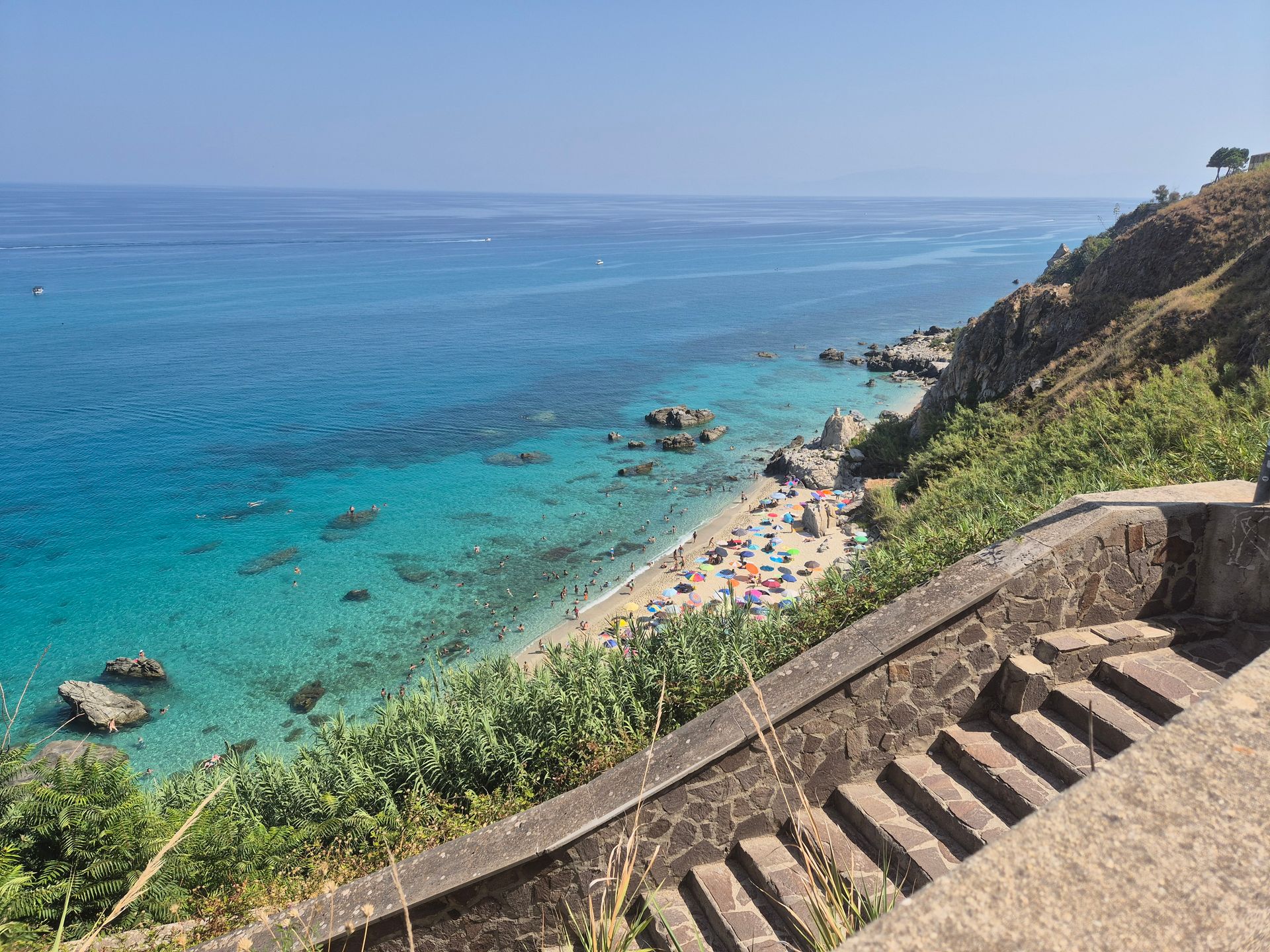
Just north of Tropea, Parghelia is a quiet village with none of Tropea's crowds. Its main beach, Spiaggia Michelino, is a free beach reached by a staircase of over 200 steps — a bit of effort, but it's rewarded with white sand, clear water, and views toward Stromboli that are some of the best on the whole coast.
✨ In my opinion, Spiaggia Michelino might just be the most beautiful beach on this whole itinerary — genuinely stunning, and far less crowded than anything in Tropea.
Afternoon — Zambrone
Head to the aptly named Paradiso del Sub ("Diver's Paradise") — a cove famous for its clear water and rich seabed, perfect for snorkelling if you've brought gear. It has a smaller, more local scene than the beaches around Capo Vaticano.
Day 4 — Boat Tour (& Optional Pizzo Calabro)
Your last day is built around the boat tour — the rest is a flexible bonus if you have the time and energy.
Morning — Boat tour (a must)
Don't leave without seeing the Costa degli Dei from the water — these beaches are genuinely a different experience seen from a boat, with the chance to jump in and swim right alongside the fish.
A quick note on which tour to pick: you'll come across two very different options. Some tours head out to the Aeolian Islands, but I wouldn't recommend it — the islands are numerous and far away, so you end up on a huge boat packed with people and spend most of the day on the crossing rather than actually enjoying the water. Instead, go for a half-day boat tour along the Costa degli Dei itself — shorter, closer, and far more about the swimming and the coastline than the boat ride.
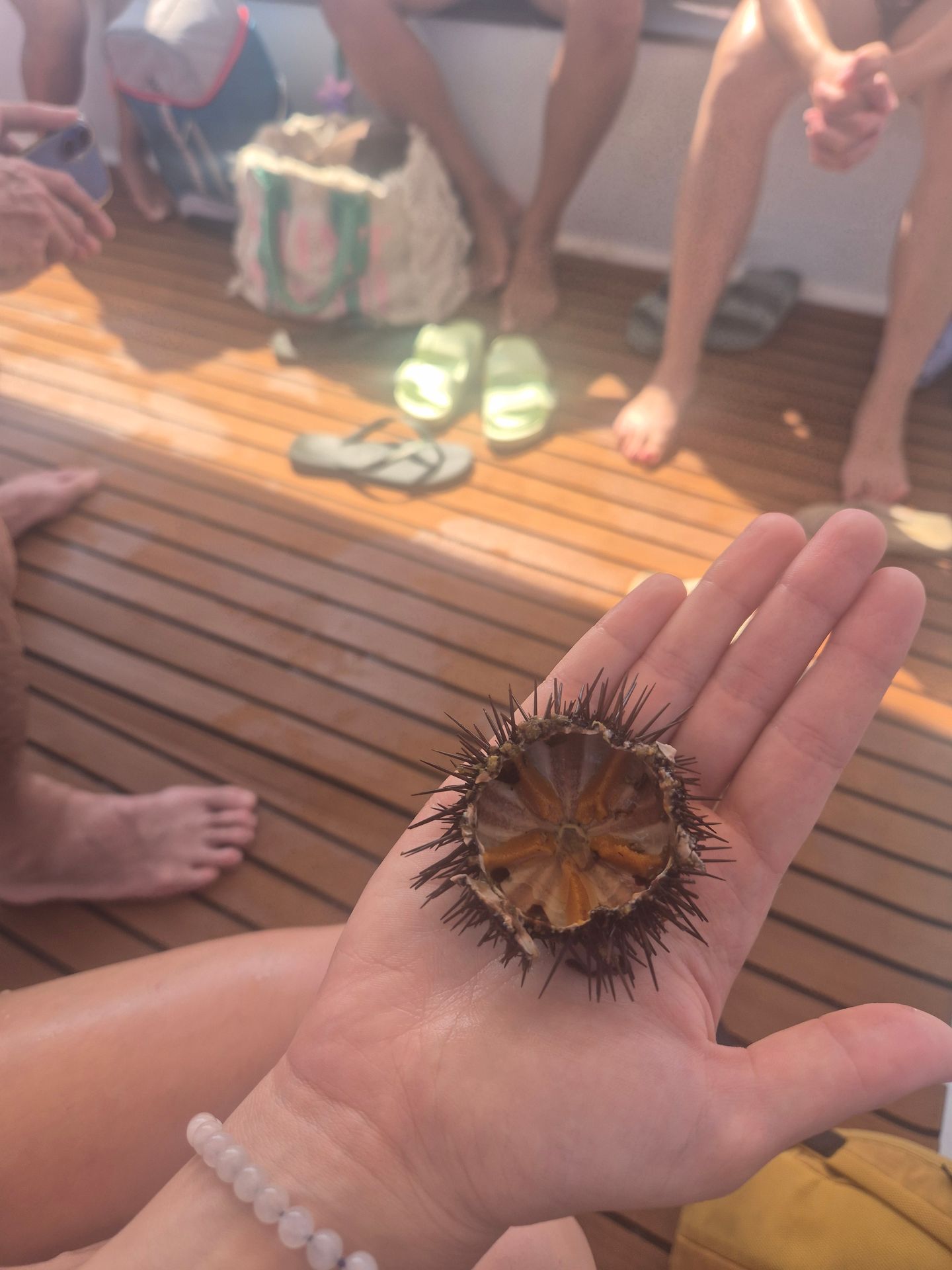
✨I booked a small tour with about 12 people, which felt intimate and authentic rather than crowded, and it was genuinely one of the best parts of the trip — including an aperitivo on board with sea urchins fished fresh right there on the spot. Honestly some of the best I've ever had.
👉 Book this boat tour here 🔗
Bonus — Pizzo Calabro
This itinerary is already fairly packed, so treat Pizzo as optional — worth it if you have an extra afternoon and the energy for one more stop, easy to skip if you'd rather end on the boat tour and relax.
If you do go: drive north along the coast to Pizzo, a cliffside town with its own dramatic character, built on a rocky spur overlooking the Golfo di Sant'Eufemia. Start in Largo Ercole, the historic heart of town, and walk through Largo Galluppi to Largo Villetta. Visit the 15th-century Castello Murat, built by the Aragonese and best known as the place where Napoleon's general Joachim Murat, King of Naples, was imprisoned and executed in 1815 — the castle now houses a small museum on his story. Nearby, the Chiesa Matrice di San Giorgio holds Murat's tomb, and along the seafront you'll find the striking Chiesetta di Piedigrotta, a small church carved entirely out of tufa rock, built (according to legend) by shipwrecked sailors giving thanks for their survival.
Wander the narrow lanes behind the main square, where you can still find artisan workshops — ceramicists at work in their studios and, down by the water, small boatyards building traditional fishing boats by hand.
✨ No trip to Pizzo is complete without a tartufo — the town's signature gelato, a hazelnut and chocolate dome with a molten chocolate centre, invented here in the 1950s. Grab one in Piazza della Repubblica, where half a dozen gelaterie compete for the title of best in town.
⚠️ If you're flying out of Lamezia Terme, Pizzo is roughly 30–40 minutes from the airport — a convenient last stop before your flight.
Related Articles
| A Local's 2 Week Itinerary Sicily |
| What to see in Palermo Sicily Italy |
| Best Food in Sicily Italy |