One Week Itinerary in the Faroe Islands


Crafting the perfect vacation can be an adventure in itself. If you’re dreaming of dramatic cliffs, misty fjords, colorful villages, and some of the most untouched landscapes in Europe, the Faroe Islands are an unforgettable destination. Tucked away in the North Atlantic between Iceland and Norway, this remote archipelago offers a rare blend of wild nature, Viking heritage, and peaceful Nordic charm.
Whether you're a passionate hiker, a photographer chasing epic coastal views, or a traveler seeking destinations far from the crowds, the Faroe Islands deliver an experience unlike anywhere else. From towering sea cliffs and hidden waterfalls to charming turf-roof houses and scenic drives, every day here feels like stepping into a postcard.
This one-week itinerary will guide you through the very best the islands have to offer. You’ll explore iconic sights like the famous cliffside lake of Sørvágsvatn, wander through the historic streets of Tórshavn, and experience breathtaking landscapes on islands such as Kalsoy and Vágar.
👉 Map of the full itinerary here🔗.
Heads up: this page may include affiliate links. By clicking and/or purchasing, I may receive a small commission at no extra cost for you. I only recommend tools I have personally vetted.
Practical Information
Location
The Faroe Islands are a remote archipelago in the North Atlantic Ocean, located roughly halfway between Iceland and Norway. Politically, they are an autonomous territory within the Kingdom of Denmark.
Composed of 18 rugged volcanic islands, the Faroes are famous for their dramatic landscapes: towering sea cliffs, deep fjords, cascading waterfalls, and green valleys dotted with small villages and turf-roof houses. Despite their remote location, the islands are surprisingly accessible and connected by an impressive network of tunnels, bridges, and ferries.
The capital, Tórshavn, is one of the smallest capitals in the world but full of charm, with colorful houses, a historic harbor, and a vibrant local food scene. Beyond the capital, destinations like Vágar, Eysturoy, and Kalsoy offer some of the most breathtaking landscapes in Northern Europe.
Transportation & Exploration
✈️ By Plane: The main gateway to the islands is Vágar Airport, located on the island of Vágar. It offers regular flights to several European cities, especially via Copenhagen. From the airport, you can reach Tórshavn in about 45 minutes by car through a subsea tunnel.
👉 You can book your plane ticket here 🔗.
🚗 By Car: Renting a car is by far the best way to explore the Faroe Islands. The road infrastructure is excellent, with scenic coastal routes, subsea tunnels connecting islands, and spectacular viewpoints around nearly every corner.
Driving allows you to easily reach remote villages, hidden waterfalls, and iconic sights.
⚠️ Some tunnels require a small toll, automatically charged to your rental car.
👉 You can book your car on Booking 🔗 or Rentalcars 🔗.
⛴ By Ferry: Several ferries connect islands that are not linked by tunnels or bridges. One of the most popular routes is from Klaksvík to the island of Kalsoy, a must for hikers heading to the famous lighthouse viewpoint.
⚠️ Ferries are efficient and usually run multiple times a day, but schedules can change depending on weather conditions.
🚌 By Bus: The Faroe Islands have a reliable public bus network, with many routes departing from Tórshavn. Some intercity buses are even free of charge, which makes them a good option for budget travelers.
⚠️ However, buses are less flexible than driving, especially if you want to explore remote hiking areas or small villages.
🚶♂️On Foot: Villages and towns in the Faroes are small and extremely walkable. Places like Gjógv, Saksun, and Tórshavn are perfect for wandering slowly, enjoying colorful houses, dramatic coastal views, and quiet harbors.
👉 Bring good hiking shoes, as many of the islands’ best experiences involve short walks or scenic hikes.
Weather
The Faroe Islands have a subpolar oceanic climate, meaning temperatures remain relatively mild throughout the year but weather can change quickly.
🌤 Summer (June to August): Cool and bright, usually 10°C–15°C (50°F–59°F). Long daylight hours and greener landscapes make this the best season for hiking and photography.
🍂 Autumn (September to November): Temperatures drop to 7°C–12°C (45°F–54°F). Stormier weather arrives, but dramatic clouds and fewer tourists create a magical atmosphere.
❄️ Winter (December to February): Cold, windy, and dark, with temperatures around 3°C–7°C (37°F–45°F). Snow is possible but not extremely common.
🌸 Spring (March to May): Gradually warming to 5°C–10°C (41°F–50°F). Puffins begin returning to the cliffs and the islands slowly come back to life.
⚠️ The Faroese often say you can experience four seasons in one day, so always bring layers and waterproof clothing.
Accommodation
Although the Faroe Islands may look small on the map, getting around takes longer than you might expect. For this reason, I decided to stay in several different locations across the islands. In my experience, Vágar Island, Klaksvík, and Tórshavn make the best bases for exploring the surrounding landscapes.
Below, you’ll find my recommendations:
- Vágar: Hotel Vagar 🅱️ Booking 🔗 🆃 Trip.com 🔗🦉 Tripadvisor 🔗
- Klaksvík: Sea View Suite 🅱️ Booking 🔗
- Tórshavn: In the heart of Tórshavn 🅱️ Booking 🔗 🆃 Trip.com 🔗
⚠️ Book well in advance, as accommodation options in the Faroe Islands are limited.
Vágar Island
Located in the western part of the archipelago, Vágar is the main gateway to the Faroe Islands and the first place most travelers set foot in the country. The island is home to Vágar Airport, the only international airport in the Faroes, making it the starting point for almost every journey through this remote North Atlantic archipelago.
However, Vágar is far more than just an arrival point. With its dramatic coastal landscapes, towering cliffs, rolling green hills, and small picturesque villages, the island perfectly captures the wild beauty that makes the Faroe Islands so unique. Easily accessible and relatively compact, Vágar is an excellent place to begin exploring the archipelago and offers visitors a first taste of the breathtaking scenery that awaits across the islands.
On this island, I recommend visiting:
Bøur🔗
Visit the picturesque village of Bøur, known for its charming turf-roofed houses and stunning views of Tindhólmur and Mykines islands. Take a stroll around the village and enjoy the scenery.

Village of Gasadalur🔗
Head to this village to witness the iconic Mulafossur waterfall cascading into the ocean. Capture the breathtaking sunset over the cliffs.
👉 Reachable by car and doesn't require hiking to photograph the iconic waterfall.

Lake Sørvágsvatn🔗 (Leitisvatn) and Trælanípa cliffs🔗
Often considered one of the most extraordinary natural wonders in the Faroe Islands, this spot offers a truly unforgettable sight. From the cliff’s edge, the lake creates a remarkable optical illusion, appearing as if it is suspended high above the ocean below. The dramatic perspective—combined with the surrounding cliffs and the vast Atlantic stretching into the distance—makes it one of the most iconic and photographed landscapes in the archipelago.
Reaching the viewpoint requires a scenic hike of about 45 minutes, following a relatively easy trail across open grassy terrain with stunning coastal views along the way. The walk itself is part of the experience, gradually revealing the dramatic landscape as you approach the cliffs.
⚠️ Access to the area is managed by local landowners, and visitors are required to pay an entrance fee of 200 DKK (around €27) per person to use the trail.

Village of Sandavágur🔗
The charming village of Sandavágur is a place where history and peaceful Faroese village life come together. Nestled along a quiet bay on the island of Vágar, it is known for its scenic surroundings, colorful houses, and relaxed atmosphere.
One of the village’s highlights is the picturesque Sandavágur Church, a beautiful white church with a striking red roof that stands proudly above the village. The area is also historically significant, as archaeological discoveries suggest that one of the earliest Viking settlements in the Faroe Islands was established here. According to local tradition, the Viking chieftain Tórbjørn the Red settled in Sandavágur more than a thousand years ago.
Today, the village is perfect for a slow and relaxing walk. Stroll along the quiet streets, enjoy views of the surrounding fjord and mountains, and take a moment to soak in the atmosphere of one of the Faroes’ oldest communities. It’s a wonderful place to connect with the islands’ deep history while experiencing the tranquility of everyday life in this remote North Atlantic archipelago.
Mykines Island🔗
For a truly unforgettable experience, take a boat excursion to the remote island of Mykines, often considered one of the most spectacular destinations in the Faroe Islands. Located on the western edge of the archipelago, Mykines is famous for its extraordinary birdlife and dramatic natural scenery.
The island is best known for its large colonies of Atlantic puffins, which nest here during the summer months. As you walk across the grassy hills and coastal cliffs, it’s common to see puffins flying overhead, resting in burrows, or waddling across the landscape—often surprisingly close to visitors. In addition to puffins, Mykines is also home to thousands of other seabirds, making it one of the most important birdwatching locations in the North Atlantic.
One of the highlights of visiting the island is the scenic hike toward the iconic Mykineshólmur Lighthouse. The trail crosses a narrow footbridge and leads to breathtaking viewpoints over towering cliffs and the open Atlantic Ocean. Along the way, you’ll likely encounter seabirds nesting along the cliffs and soaring through the strong ocean winds.
👉 Embark on a boat tour🔗 to explore the island


Sørvágur🔗
Visit the picturesque village of Sørvágur, one of the oldest settlements on the island of Vágar. Nestled along a quiet fjord and surrounded by green mountains, the village offers a charming glimpse into traditional Faroese life. Strolling through its peaceful streets, you’ll notice colorful wooden houses, small harbors with fishing boats, and beautiful views over the water.
Sørvágur has a long history dating back to the Viking Age, and walking around the village is a great way to connect with the islands’ cultural heritage. Take some time to wander along the waterfront, explore the historic center, and learn about the traditions and daily life of the Faroese people.
⭐ Bonus Mention: Drangarnir🔗
Although I didn’t include it in my itinerary, this spectacular natural landmark is definitely worth mentioning. Drangarnir are two dramatic sea stacks rising from the ocean just off the coast of Vágar, creating one of the most iconic landscapes in the Faroe Islands.
⚠️ The site can only be visited with a licensed guide, as the trail crosses private land and involves some challenging terrain. Guided hikes usually cost around 600 DKK (about €80) per person. While the experience is more expensive than other hikes in the Faroes, the views of the sea stacks, cliffs, and the vast Atlantic Ocean are truly breathtaking.
👉 This boat tour🔗 is an easy way to reach this beautiful spot.

North Streymoy Island
Vestmanna Sea Cliffs🔗 and Kvívík🔗
Take a boat tour from the village of Vestmanna to explore the spectacular sea cliffs along the west coast of Streymoy. This excursion is one of the most popular experiences in the archipelago and offers a unique perspective of the islands from the water. As the boat navigates beneath towering cliffs, you’ll pass dramatic rock formations, narrow passages, and sea caves carved by centuries of powerful Atlantic waves. During the summer months, the cliffs are also alive with thousands of seabirds nesting along the steep walls, creating an unforgettable wildlife spectacle.
Village of Saksun🔗
Drive to the stunning village of Saksun—without a doubt one of the must-see locations in the Faroe Islands. Hidden deep within a dramatic valley on the island of Streymoy, Saksun feels almost frozen in time. The village is surrounded by steep green mountains and dramatic cliffs, creating one of the most iconic landscapes in the archipelago. Traditional turf-roof houses scattered across the valley add to its magical and timeless atmosphere.
From the village, take a peaceful walk down toward the tidal lagoon, where the ocean enters through a narrow opening between the cliffs. At low tide, you can walk across the sandy flats and enjoy breathtaking views of the surrounding mountains and coastline. The quiet, remote setting makes Saksun a perfect place to slow down and soak in the raw beauty of the Faroese landscape.
If you have extra time, continue your drive to the charming village of Tjørnuvík, located at the northern end of Streymoy. This picturesque settlement is famous for its beautiful black sand beach, which contrasts dramatically with the lush green cliffs that surround the bay. It’s a wonderful spot for a relaxing stroll along the shore or simply to sit and admire the powerful Atlantic waves.
✨ Tjørnuvík is also known as one of the best surfing spots in the Faroe Islands, attracting adventurous surfers who come to ride its cold but impressive waves. Whether you’re exploring the beach, enjoying the dramatic scenery, or watching surfers in action, the village offers a memorable and scenic stop during your journey.


Eysturoy Island
Village of Eiði🔗
Located on the northern coast of Eysturoy. Here, you can visit the iconic sea stacks known as the Risin og Kellingin (The Giant and the Witch). These towering rock formations rising from the sea are a must-see attraction.
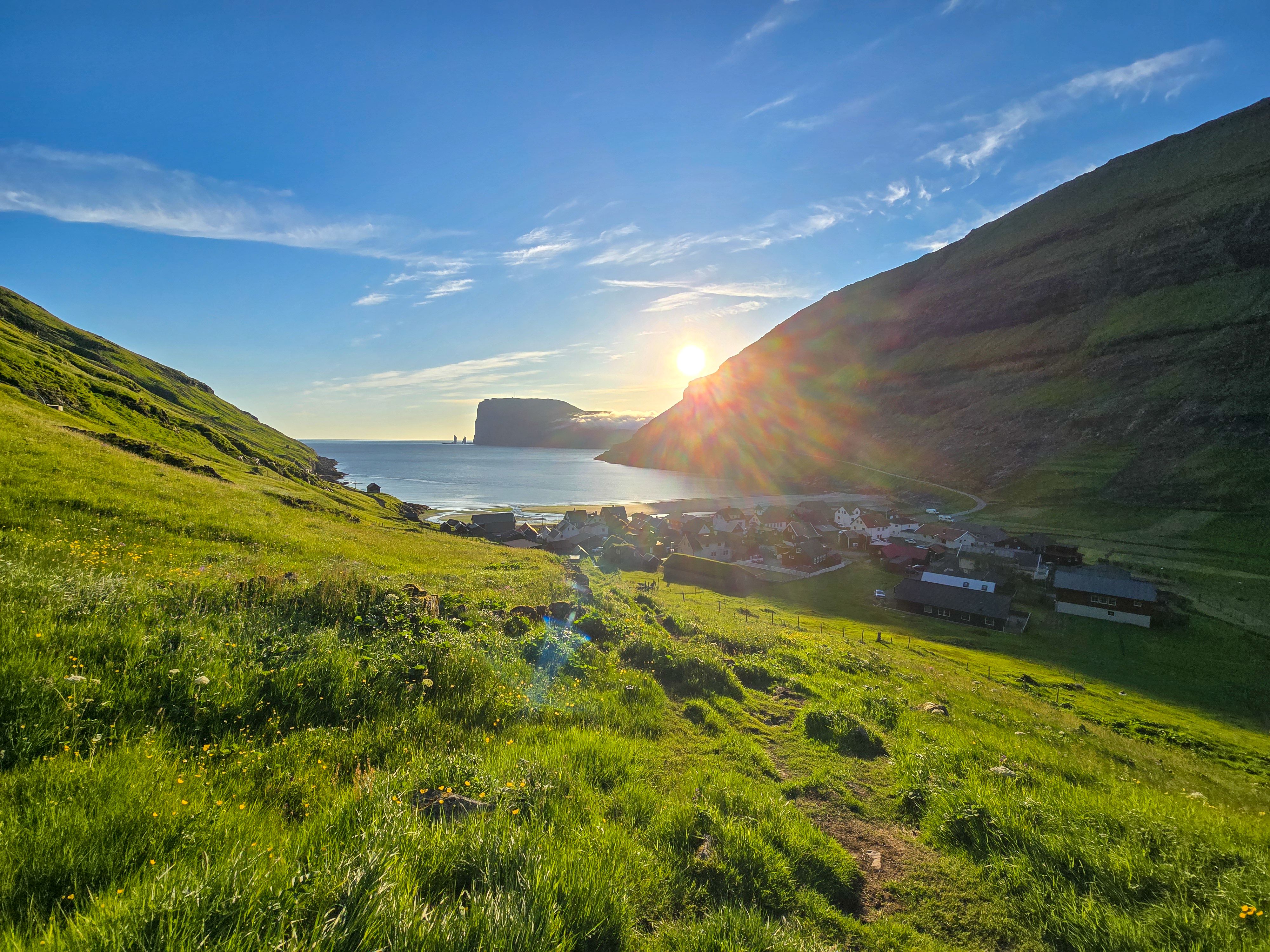
Hike to Eiðiskollur🔗
For a memorable adventure, consider taking a short hike to Eiðiskollur, a scenic spot that offers stunning panoramic views of the Risin og Kellingin sea stacks and the surrounding coastline. The trail is relatively easy and winds through typical Faroese landscapes of rolling green hills and rugged terrain, giving you a true sense of the islands’ wild beauty.
✨ If you prefer something less strenuous, there is also a more accessible viewpoint🔗 nearby, where you can still admire the iconic sea stacks without committing to the full hike. Both options provide excellent opportunities for photography and to simply soak in the dramatic scenery.

Village of Gjógv🔗
Nestled on the northern tip of Eysturoy, Gjógv is one of the most picturesque villages in the Faroe Islands, famous for its natural harbor carved into a dramatic gorge and its breathtaking coastal cliffs. The village exudes traditional Faroese charm, with historic turf-roofed houses, narrow lanes, and colorful cottages that seem perfectly framed by the surrounding mountains and ocean.
Take a leisurely stroll through the village, explore the quaint streets, and enjoy the views along the scenic coastline where waves crash against rugged cliffs. For those with a bit more energy, a hike to the nearby mountain pass rewards you with sweeping panoramic vistas of the village, the Atlantic Ocean, and the neighboring islands—a perfect way to capture the wild beauty and tranquility that make Gjógv so special.

Klaksvík and Kalsoy Islands
Klaksvík is the second-largest town in the Faroe Islands and serves as the main hub for the Northern Isles region. It's situated on the island of Borðoy, which is part of the Norðoyar (Northern Islands) group.
Here's an itinerary to explore Klaksvík and the islands around it:
Klaksvík🔗
I highly recommend dedicating a day to exploring this charming town, which boasts a wider array of restaurants and shops compared to the smaller villages. Take a leisurely stroll through its streets to admire the captivating traditional Faroese architecture, and don't miss the chance to pause for a coffee at one of the cozy local cafés.

Klakkur hike🔗
I strongly advise against overlooking this accessible hike, which offers breathtaking panoramic views. Beginning from Klaksvík, it promises an unforgettable experience amidst the Faroese landscapes.

Mikladalur🔗
Visit the charming village of Mikladalur, known for its historic significance and traditional turf-roofed houses. Don't miss the opportunity to see the iconic statue of the Seal Woman (Kópakonan) and learn about the local legends.

Kallur Lighthouse🔗
Head over the village of Trøllanes🔗, located at the northern tip of the island. This small settlement is known for its picturesque setting and traditional Faroese houses with grass roofs, surrounded by dramatic cliffs and open ocean views.
Embark on the iconic hike to Kallur Lighthouse🔗, one of the most famous landmarks in the Faroe Islands. The trail offers breathtaking views of steep cliffs, the rugged coastline, and several surrounding islands, making it one of the most spectacular viewpoints in the archipelago.
👉 The hike takes about 1 hour to reach the lighthouse, depending on your pace. Be sure to wear sturdy footwear and dress appropriately for the often unpredictable Faroese weather, as conditions can change quickly.
💸 Access to the trail requires a fee of DKK 450 per adult, which is paid locally and helps support land access and trail maintenance.

✨ There are many beautiful islands to explore in the Faroe Islands. However, in my opinion, Kalsoy is an absolute must-see. If you have extra time in your itinerary, you can certainly add visits to other islands as well.
Tórshavn and Nólsoy Island
Tórshavn🔗
Not everyone includes Tórshavn in their itinerary, but I’m glad I did. As the capital of the Faroe Islands, it offers a bit more energy and atmosphere compared to the small villages scattered across the archipelago.
What to see in Tórshavn:
- Tinganes: The historic district of Tórshavn. Wander through its narrow lanes lined with colorful, turf-roofed wooden houses that have been in use for centuries. Here you’ll also find the Tinganes Parliament buildings, where the Faroese government still meets today.
- City center: Take some time to explore the center of town. Browse the small shops and boutiques selling locally made wool products, ceramics, and unique souvenirs. It’s also the perfect place to stop at one of the cozy cafés for a coffee and try a traditional Faroese pastry or cake.
👉 You can join this walking tour🔗 to dive deeper into the city’s history.
- Kirkjubøargarður: Located just outside the city, this remarkable farmhouse is one of the oldest continuously inhabited wooden houses in the world and offers a fascinating glimpse into Faroese history.

Nólsoy Island🔗
I also visited Nólsoy Island, which I wouldn’t necessarily describe as a must-see attraction, but it is still definitely worth a visit if you have extra time. It offers a peaceful atmosphere, charming scenery, and an authentic glimpse into local life away from the more touristic spots.

A week in the Faroe Islands promises an unforgettable adventure through stunning landscapes and rich cultural heritage. From the historic streets of Tórshavn to the rugged beauty of Kalsoy and Eysturoy, each day brings new discoveries. Whether you're a nature lover or history enthusiast, the Faroes offer something for everyone. Pack your bags and embark on this remarkable journey – your one-week itinerary is sure to create memories that will last a lifetime.
Related Articles
| 10 Essential Things to Know Before Visiting the Faroe Islands |